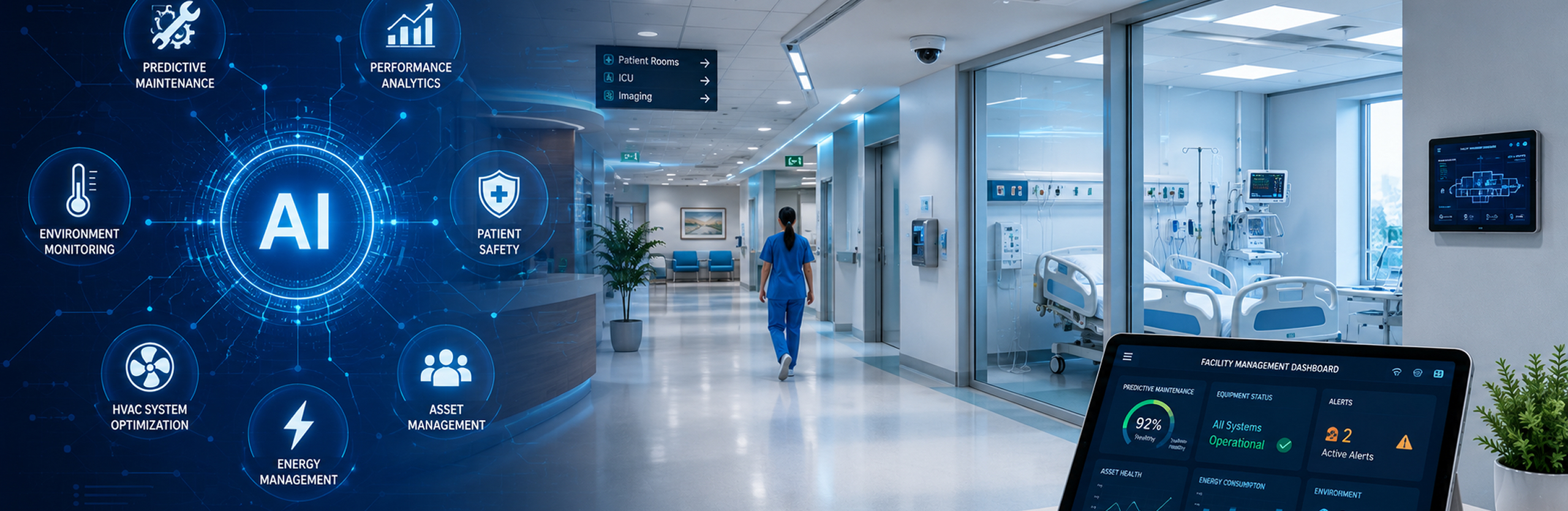

AI in Healthcare Facilities Management: From Predictive Maintenance to Improved Patient Safety
A healthcare facility is a complex environment where every system plays a crucial role.
From HVAC and electrical systems to medical gases, emergency power, and fire protection, these services must perform reliably to support clinical operations and maintain a safe environment.
As healthcare facilities expand and equipment networks grow more sophisticated, maintaining these systems efficiently has become challenging.
Maintenance teams must also meet strict safety and compliance requirements while preventing avoidable failures that could disrupt operations.
This is where AI in healthcare makes a meaningful difference, particularly in monitoring, predictive maintenance, energy management, and operational planning.
The Role of AI in Healthcare Facilities Management
Traditional maintenance models generally rely on routines or corrective interventions.
Facility teams establish maintenance plans based on manufacturer recommendations, regulatory requirements, asset age, operating hours, and previous maintenance records.
While this approach provides a structured maintenance framework, it may not detect changes that occur between scheduled inspections.
Artificial Intelligence adds a layer of analysis by processing information gathered through sensors, Building Management Systems (BMS), Computerized Maintenance Management Systems (CMMS), and other platforms.
By comparing current performance with historical patterns, AI highlights changes warranting further investigation and improves responsiveness in healthcare facility maintenance.
This forms the basis of predictive maintenance: using operational data to identify potential failures sufficiently early for appropriate intervention.
Transitioning from Preventive to Predictive Maintenance
Preventive maintenance, guided by manufacturer recommendations, operating conditions, maintenance history, or predetermined schedules, remains an important part of healthcare facility maintenance.
While preventive maintenance takes a precautionary approach, assets can often run much longer without intervention. AI analysis in FM helps facilities maximize asset utilization while detecting anomalies and alerting operators to intervene at the right time, before a breakdown.
Even in perfect maintenance schedules, a component might start deteriorating shortly after an inspection, or an asset operating under heavier conditions may require attention sooner than anticipated.
Predictive maintenance addresses this gap by leveraging equipment data to assess condition over time.
AI analyzes variables like vibration, temperature, pressure, energy consumption, runtime, and previous maintenance records. When these indicators deviate from normal patterns, the system flags the operators to review the change.
For organizations implementing predictive maintenance strategies in the UAE, this approach can enhance asset utilization, support prompt intervention, reduce unexpected failures, and address emerging issues before they escalate into operational problems.
Read more: What Role Does Healthcare Facilities Management Play in Infection Control in UAE Hospitals in 2026?
Prioritizing Critical Healthcare Assets
A fault in a non-critical system may be inconvenient, while a failure involving emergency power, medical gases, essential HVAC systems, or temperature-controlled environments can have far-reaching consequences.
Effective healthcare facilities management therefore requires a clear understanding of asset criticality.
And AI-supported monitoring systems combine equipment performance, maintenance history, and asset criticality to support this assessment.
This provides a clearer basis for resource allocation and allows teams to focus on systems where intervention is the most important, making maintenance planning more focused and practical.
Enhancing Patient Safety
The physical environment in which healthcare is delivered must remain within appropriate conditions, including temperature, ventilation, air quality, electrical supply, water systems, emergency power, and fire protection.
Continuous monitoring helps identify unusual operating conditions and prioritize assets requiring technical investigation.
Within professional healthcare facility maintenance, AI functions primarily as an analytical and decision-support capability.
Technical personnel remain responsible for validating alerts, assessing the underlying issue, and determining the appropriate maintenance response.
This combination of predictive analytics and engineering expertise is particularly important in healthcare, where maintenance decisions can have operational and safety implications.
Improving Energy Efficiency
Healthcare facilities operate around the clock, making energy consumption a significant operational consideration.
HVAC and ventilation systems, lighting, refrigeration, pumps, and other equipment collectively account for substantial energy use.
Inefficient operation increases utility costs and places additional strain on equipment.
AI can analyze energy consumption alongside occupancy, environmental conditions, operating schedules, and equipment behavior to identify unusual patterns.
These insights can help facility teams investigate unnecessary consumption and identify areas for improvements in system efficiency.
For organizations focused on healthcare facilities management in the UAE, this connection bridges day-to-day facility performance with longer-term cost-control and sustainability goals.
Final Perspective: A Smarter Approach to Healthcare FM
AI is changing how healthcare organizations approach asset monitoring, predictive maintenance, energy management, and operational planning.
Its greatest value, however, comes from combining technology with reliable processes and technical expertise.
Turning Maintenance Records into Valuable Insights
Healthcare facilities generate substantial maintenance data, including inspection reports, work orders, service histories, testing records, and corrective actions.
Maintaining these records is essential, but their greater value comes from identifying patterns within them.
Digital FM platforms can consolidate this information, while AI pinpoints recurring faults, overdue tasks, or assets requiring more frequent attention.
Facility managers can therefore gain a clearer view of asset performance and use historical information to support future maintenance planning.
For healthcare facility management companies, organized operational data also supports consistent reporting and provides clients with a transparent view of ongoing FM activities.
Integration: AI in the FM Circle
For healthcare facilities, effective AI adoption depends on accurate data, structured maintenance programs, integrated digital systems, and consistent engineering oversight.
Together, these elements create a more responsive approach to facility operations while supporting asset reliability, efficiency, compliance, and patient safety.
For organizations across the UAE, AI should therefore be viewed as an evolution toward smarter and more proactive facility management.
However, specialization and compliance management matter equally.
This is where Al Arabia Facilities Management L.L.C. brings together its decades of technical expertise, planned maintenance, and technology-enabled solutions to help organizations manage complex healthcare environments, protect critical assets, and maintain reliable facility operations across the UAE.